279Tested
Flutter tests passed
Current local working tree · audited Nov 20, 2026
Mobile + API platform
A Flutter application and FastAPI backend for collection tracking, card recognition, cached market data, and evidence-based grading.
Authentic product UI
Authentic July 2026 interface captures covering collection browsing and set-level progress. Additional TCGs remain presented as Coming Soon. Neither image depicts scanner functionality.
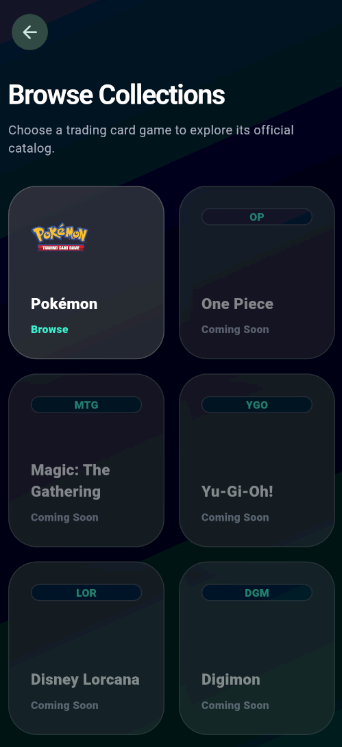
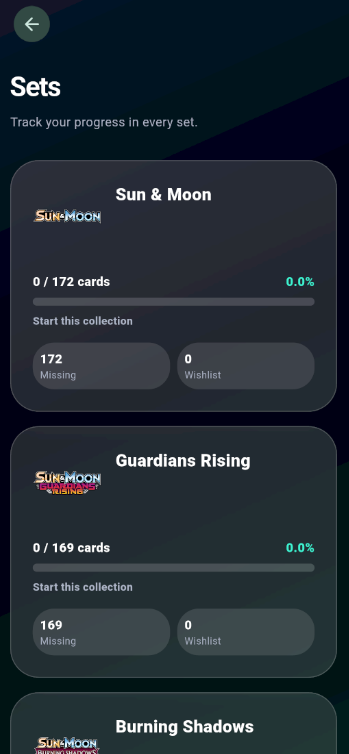
Current local working tree · audited Nov 20, 2026
Clean API worktree · 51 environment/platform-gated skips
Subset of the API total · 9 gated skips
Subset of the API total
Scanner and grading results are focused subsets of the 2,866-test API suite, not additional tests. No production accuracy or performance benchmark is claimed.
Collectors need one workflow that can organize cards, retrieve market context, recognize physical cards, and explain grading evidence without turning an uncertain scan into a confident result. GradingFy connects those steps while preserving the boundary between a useful suggestion and a verified match.
The work spans the Flutter/Dart client, Python/FastAPI services, PostgreSQL/Supabase persistence, and the contracts connecting capture, collection, recognition, and grading flows.
The scanner starts OCR and visual retrieval in parallel, treating OCR as optional evidence rather than a single point of failure. Visual candidates come from a server-side fingerprint index that publishes only when its rows match a committed manifest. Invalid modes, stale generations, malformed pages, or manifest mismatches fail closed instead of producing an automatic match. Sequential pagination and explicit cache invalidation keep index loading bounded and observable.
The mobile client sends captured evidence through API contracts rather than embedding recognition logic in UI code. On the service side, recognition and grading are separated: the scanner retrieves and ranks candidates, while grading modules evaluate capture quality, structure, surface, corners, edges, print quality, explanations, prediction, and calibration. This separation makes abstention, evaluation, and failure recovery testable at their own boundaries.
A fresh November 20, 2026 audit ran the Flutter suite against the current local working tree and the full Python suite against a clean API worktree. The result was 279 passing Flutter tests and 2,866 passing API tests with 51 environment/platform-gated skips. Focused reruns identified 2,154 scanner passes with 9 skips and 395 grading-related passes; both counts are contained within the API total. The scanner tests exercise cache reuse, invalidation, load recovery, bounded candidate scoring, and safe failure behavior on synthetic inputs.
Recognition quality depends as much on evidence provenance and abstention rules as it does on ranking logic. The design therefore makes trust explicit: an index must be manifest-verified, an outage cannot silently become a match, and synthetic evaluation cannot be presented as production accuracy. A constrained resource-benchmark harness exists, but it has not been executed, so this case study makes no latency, memory, throughput, or accuracy claim.
Validation evidence · audited Nov 20, 2026
The current mobile working tree passed 279 Flutter tests. A clean API worktree passed 2,866 tests with 51 documented environment/platform-gated skips. The previously reported historical count was not reproducible and has been removed.
View public GitHub profile