290Tested
Desktop assertions passed
Current .NET validation executable · audited Nov 20, 2026
Desktop + licensing system
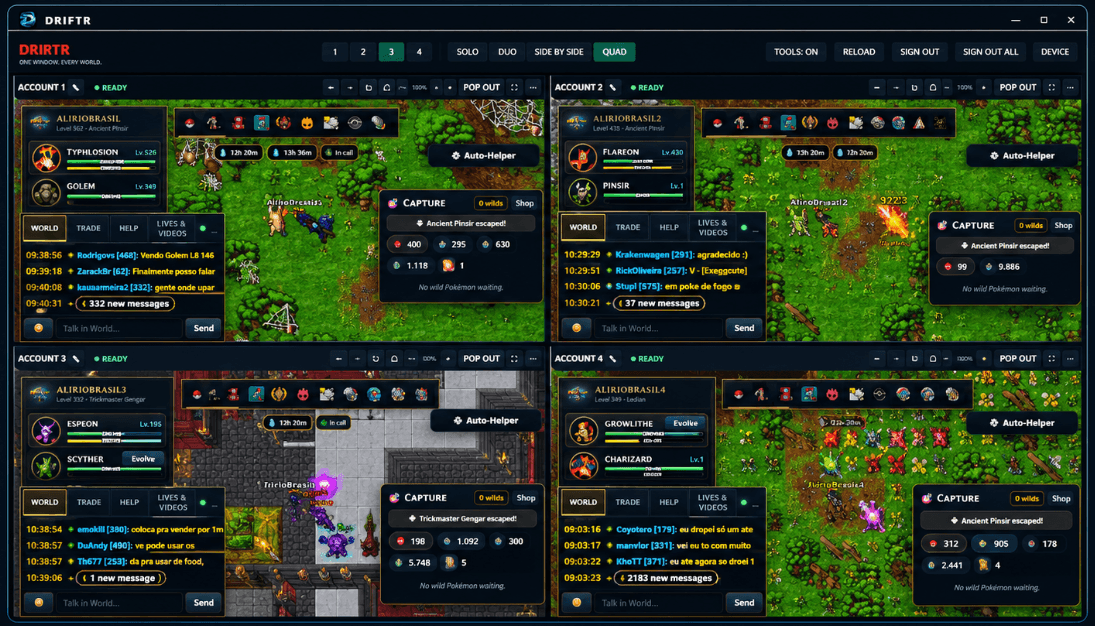
A .NET 8 WPF desktop application for isolated browser sessions, backed by a FastAPI licensing service with device-aware authentication.
Current .NET validation executable · audited Nov 20, 2026
Clean service worktree · 16 test-database-gated skips
Subset of the 410-test licensing total
Reported project usage over a one-month period
The focused authentication result is part of the licensing total. Usage describes a project-reported audience, not an audited active-license count. No multi-hour stress result is claimed.
DRIFTR gives one Windows desktop application control over one to four independent browser sessions without blending their cookies, storage, identity, or account state. That desktop experience must remain responsive while licensing decisions stay server-authoritative. The application has had more than 10 users over a one-month period. This is a reported usage figure rather than an independent production-analytics audit.
The system combines a C#/.NET 8 WPF client using WebView2 with a Python/FastAPI licensing service using SQLAlchemy and Alembic.
Each entitled account maps to a stable WebView2 profile directory. Layout changes reposition existing controls instead of recreating browsers, preserving session identity as windows move between docked and detached states. The licensing service issues short-lived access tokens and rotating refresh tokens; the desktop client stores the session as one DPAPI-protected unit and replaces it atomically so access and refresh state cannot drift apart.
SOLO, DUO, QUAD, and three-session policies calculate placement independently from profile ownership. Saved account selections, Duo orientation, detached-window state, and visible bounds are restored only when allowed by the current entitlement. A Pro-to-Free change retires extra sessions from the active UI without deleting their profile data. Legacy profile migration copies compatible browser state once, preserves existing DRIFTR data, and excludes licensing credentials.
The desktop validation executable runs against temporary roots and mocked HTTP handlers; its November 20, 2026 run passed 290 runtime assertions covering layouts, transitions, profile identity, persistence, migration, DPAPI storage, refresh coordination, logout, deactivation, downgrade behavior, and checkout failure handling. The licensing service passed 410 pytest cases with 16 PostgreSQL integration cases skipped because no authorized test database was supplied. A focused authentication/licensing selection passed 63 cases within that 410-test total.
The difficult boundary is continuity without privilege drift: a browser session should survive layout changes, but authorization changes must take effect immediately. Stable profile mapping, server validation, atomic local persistence, single-flight refresh, bounded retry, and refresh-token reuse protection address different sides of that boundary. The repository includes a diagnostic harness, but retained evidence does not support an hours-long stress-test claim.
Validation evidence · audited Nov 20, 2026
The current desktop suite passed 290 runtime assertions, and the clean licensing service passed 410 tests with 16 authorized-test-database cases skipped. The previous historical assertion lead was not reproducible and has been removed. The project timeline begins in October, with early repository work in late September and a substantive desktop baseline in early October.
View public GitHub profile